Bonfire night's done, the clocks have gone back, and a lot of people are about to stock up on softener salt before the weather turns and nobody fancies lugging bags in from the car. If you've ever stood in front of the salt shelf wondering whether blocks, tablets or granules are the right ones, you're not alone. It's one of the most common things we get asked.
The good news is that it's usually simple. Your softener was designed for one type, and that's the one to buy.
The three main types
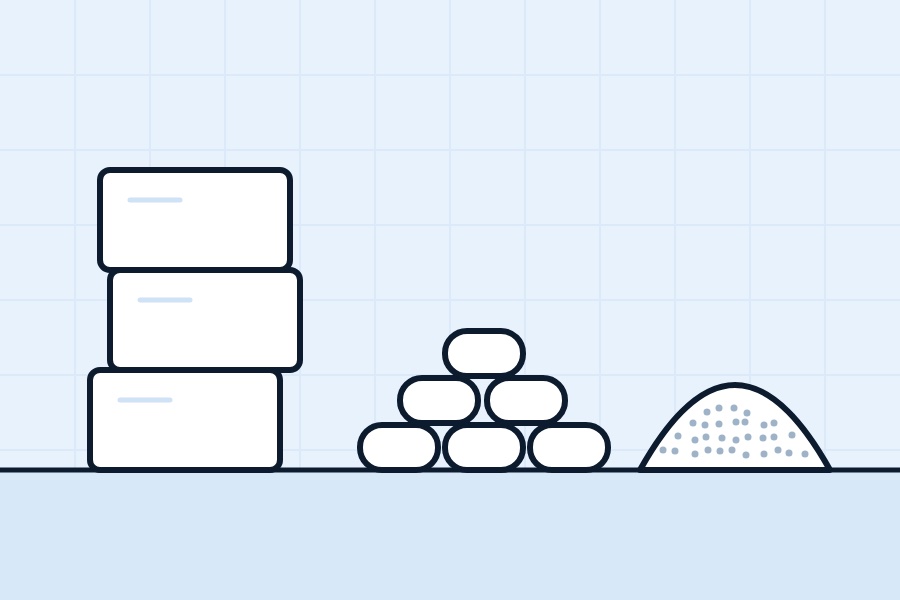
Block salt
Big, compressed blocks, usually sold in packs of a few blocks at a time. Block salt is mostly used by compact, non-electric softeners that are designed around it. You open the lid, take out the old block when it's nearly gone, and drop a new one in. Some brands use their own shape of block that only fits their units, so check before you buy a cheaper alternative.
The good bits: clean, tidy, easy to see when you need more, and less prone to clumping.
The less good bits: brand-specific blocks can cost more, and if your softener isn't designed for blocks, they won't work properly in it.
Tablet salt
Small, pillow-shaped tablets in large bags. This is what most electric softeners with a brine tank use. You pour them into the salt tank, usually keeping it somewhere between a third and two-thirds full (your manual will say).
The good bits: widely available, often cheaper per kilo than blocks, and they let water flow round them easily so brine forms properly.
The less good bits: the bags are heavy, and tablets can form a "salt bridge" if conditions are damp (more on that below).
Granular salt
Fine, loose crystals, a bit like coarse table salt. A few older or specific models are designed for it, but most modern domestic softeners aren't. In a tank designed for tablets, granular salt can turn into a dense, mushy layer that stops the softener drawing brine.
The good bits: dissolves quickly, which is why some units specify it.
The less good bits: more likely to clump and cause problems if your softener wasn't built for it.
So which one do you need?
Here's the simple rule: use the type your softener's manufacturer recommends. You'll usually find it in the manual, on a sticker under the lid, or on the maker's website if you know the model.
If you've inherited a softener and have no idea what it is, have a look at what's already in the salt compartment. Rectangular blocks in a compact unit with no plug? Block salt. A tall tank with tablets in it and a control panel on top? Tablet salt, almost certainly. If you're still not sure, take a photo of the unit and the label and give us a call. And if you've just moved in, our guide to buying a house with a water softener has a checklist of other things worth looking at.
What to look for on the bag
Buy salt that's made specifically for water softeners. It's high-purity sodium chloride, and good quality softener salt is often marked as meeting BS EN 973, the standard for salt used to regenerate ion-exchange resins. Cheaper, less pure salt can leave more insoluble gunk in the bottom of the tank, which means more cleaning.
Things not to use:
- Rock salt or gritting salt. Fine for the drive in January, not for your softener. It's full of grit and insoluble bits.
- Table or cooking salt. Too fine, and it can contain anti-caking agents you don't want in there.
- Dishwasher salt, unless your softener's manufacturer says it's suitable. It's granular, so it can cause the same mushing problems.
Some people ask about potassium chloride as a sodium-free alternative. A few softeners can use it, but not all, and it can affect how well they work. Check with the manufacturer first. If sodium in drinking water is your concern, the separate hard drinking tap we fit is the usual answer. We explain that in can you drink softened water?
Topping up without the drama
- Check it regularly. Once a month is a good habit. Pick a day and stick to it.
- Don't overfill. Stick to the level in your manual. Overfilled tanks are more likely to bridge.
- Keep it dry around the unit. Damp cupboards and garages make clumping more likely.
- Store spare bags off the floor, somewhere dry. Salt soaks up moisture and goes hard in the bag.
Salt bridges: the most common salt problem
A salt bridge is a hard crust that forms across the tank, with an empty gap underneath. From the top, the tank looks full. Underneath, the salt isn't touching the water, so no brine is being made and the softener quietly stops softening.
The giveaway is that the salt level hasn't gone down in weeks, and limescale starts creeping back on the taps. To check, gently push a broom handle down into the salt. If it hits a hard layer and then drops through, you've found a bridge. Break it up carefully without bashing the sides or the brine well, then scoop out any big lumps.
If that doesn't sort things, our water softener troubleshooting checklist covers the other usual suspects, and a yearly service includes cleaning out the brine tank and clearing any sludge.
How much salt will you use?
It depends on how hard your water is, how many people live in the house, how much water you use and how efficient your softener is. A modern metered unit is generally thriftier than an old timer-based one. We go through all the factors in how much a water softener costs to run. And if you're choosing a new softener, our installation page explains the difference between block and tablet systems.
Quick answers
Can I use tablet salt instead of block salt?
Only if your softener is designed for it. Block-salt softeners are built around blocks, and tablet-salt softeners around tablets. Use whatever the manufacturer recommends.
Can I use dishwasher salt in my water softener?
Not unless the manufacturer says it's suitable. Dishwasher salt is granular and can turn mushy in a tank designed for tablets, which stops the softener working properly.
Why isn't my softener using any salt?
The most common reason is a salt bridge, a hard crust with a gap underneath. Gently break it up with a broom handle. If the salt still isn't going down, the softener may not be regenerating and is worth checking.
Want a hand with your water?
Book a free survey and water test. We'll tell you straight whether a softener's worth it for your home.
Get a free quote