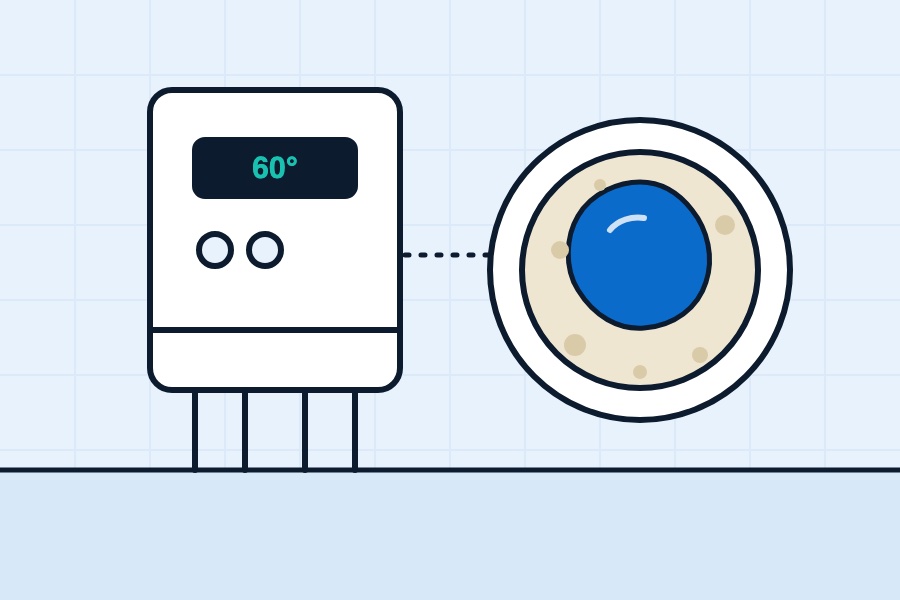
Late spring is when the heating finally goes off and nobody thinks about the boiler again until October. It's also a good time to give it a bit of thought, because the boiler still works hard all summer making your hot water. And in a hard-water area like London, hot water is exactly where limescale does its damage.
You can see limescale on your taps and in the kettle. What you can't see is the same stuff building up inside the boiler, the hot water cylinder, the dishwasher and the washing machine. Here's what's going on in there, the signs that it's starting to bite, and what actually helps.
Why heat makes limescale worse
Hard water carries dissolved calcium and magnesium. Cold, it mostly stays dissolved. Heat it up and some of it drops out as a hard, chalky crust, the same white stuff you scrape out of the kettle. The hotter the water and the more of it you heat, the faster the scale builds.
That's why anything with a heating element or a heat exchanger takes the brunt. Scale is a pretty good insulator, so a crusty element or heat exchanger has to work harder to get the same heat into the water. Over time it can also narrow small waterways and clog valves and sensors.
Combi boilers
A combi heats your hot water on demand as it passes through a small heat exchanger. Those narrow channels are a prime spot for scale. The usual signs are:
- Hot water that's slow to arrive or doesn't get as hot as it used to.
- Temperature that swings hot and cold in the shower.
- Weaker hot water flow than cold.
- Banging, whistling or "kettling" noises when the hot water's running.
To be fair to limescale, those symptoms can have other causes too, like sludge in the heating side or a faulty part. A Gas Safe registered engineer is the right person to diagnose a gas boiler fault. What we can tell you is that in hard-water areas, scale is a very common culprit on the hot water side.
One more thing worth knowing. The central heating circuit is a sealed loop that reuses the same water over and over, so it doesn't keep picking up new scale the way your hot taps do. The hot water side is the one that sees fresh, hard water every time you run a tap. If you do fit a softener, check with your boiler manufacturer or heating engineer before using softened water to fill or top up the heating system, as some manufacturers have specific guidance on that.
Hot water cylinders and immersion heaters
If you've got a cylinder rather than a combi, scale tends to collect around the coil and the immersion heater element, and as a gritty layer in the bottom of the tank. A crackling or fizzing noise as the water heats is a classic sign. Immersion elements in hard-water areas often get so crusted that they fail early.
Showers, taps and the rest
- Electric showers heat water instantly through an element, so they scale up quickly. Spluttering, dribbly flow and a shower head that sprays sideways all point to scale.
- Dishwashers have their own small built-in softener that uses dishwasher salt. Keep it topped up and set to your local hardness, or you'll get cloudy glasses and a scaly element.
- Washing machines scale up around the element too, and you'll need more detergent in hard water to get the same clean.
- Kettles and coffee machines you already know about. Coffee machines in particular can be fussy, so follow the maker's descaling advice.
What helps
Keep on top of descaling
For small things like the kettle, shower heads and taps, a regular descale with a suitable descaler or white vinegar does the job. It's a bit of a chore, but it works. Follow the manufacturer's instructions, especially for coffee machines and anything with rubber seals.
Scale protection for the boiler
In hard-water areas, boiler installers will usually talk to you about some form of scale protection for a new boiler, and some manufacturers' warranties have conditions about it. Check your paperwork, or ask whoever fitted it what's in place. Options range from small inline scale reducers on the boiler's cold feed to a full water softener for the whole house.
A whole-house water softener
A softener takes the calcium and magnesium out of the water where it comes into the house, so there's nothing left to form new scale in the boiler, cylinder, showers or appliances. That's the main difference from most scale reducers, which aim to change how scale forms rather than remove the minerals. We've written a fair comparison in water softener or scale reducer if you're weighing up the two.
A softener won't magically clear heavy scale that's already there. If your boiler's heat exchanger is badly furred up, it may still need a clean or a replacement part. Think of a softener as stopping the problem getting worse from here on.
If you're getting a new boiler fitted anyway, that's a handy time to think about a softener too, so the new kit starts life scale-free. Our water softener installation page explains how we fit them, including the separate drinking water tap we always leave on unsoftened mains water.
How hard is your water?
The harder your water, the faster all of this happens. If you're not sure where you stand, our hard water areas page has a quick postcode checker (an approximate guide, so confirm with your water supplier), and our post on checking if your area has hard water explains what the numbers mean.
Already got a softener? It can only protect your boiler if it's actually working. A yearly softener service keeps it on track, and our guide to how often to service a water softener explains why.
Quick answers
Does hard water damage boilers?
Hard water causes limescale, which can build up in a boiler's hot water heat exchanger and in cylinders and immersion heaters. Over time that can reduce performance and lead to faults. A heating engineer can tell you whether scale is the cause of a specific problem.
Will a water softener remove existing limescale?
Don't count on it. A softener stops new scale forming, but heavy existing scale in a boiler or cylinder may still need cleaning or a replacement part.
Can I fill my central heating with softened water?
Check with your boiler manufacturer or heating engineer first. Some manufacturers have specific guidance about softened water in the heating circuit, so it's often left on unsoftened mains.
Want a hand with your water?
Book a free survey and water test. We'll tell you straight whether a softener's worth it for your home.
Get a free quote